




For over 140 years the metallurgical properties relating to quality, shape and weight were the main requirement for a producer of metal becoming a London Metal Exchange (“LME”) approved brand.
Over time, however, social and environmental considerations have evolved considerably and this is reflected in the increased focus on the sourcing practices of products and materials at all stages of the value chain. Given its longstanding role in the metals industry, in October 2019, the LME introduced responsible sourcing requirements for producers of LME brands, designed to complement existing brand listing requirements and put additional focus on the origin of metal.
Designed as a primer for those not overly familiar with responsible sourcing, this article explores the evolution towards responsible sourcing and provides an overview of the drivers, associated guidance and standards behind the LME’s responsible sourcing requirements, as well as the requirements themselves.
LME brand registration requirements - pre-October 2019
Prior to October 2019 the requirements for producers to list metals on the LME focused on shape, size, weight and other metallurgical details such as purity. Producers also had to evidence a minimum track record in the business, a minimum production capacity (which differs from metal to metal) and provide references from clients.
Whilst these requirements have not changed, the LME has since introduced additional requirements which focus on the provenance of metal. The LME continues to maintain a list of brands that are approved for good delivery against LME contracts.Responsible sourcing - the rationale and guiding principles
The LME decided to introduce new responsible sourcing requirements because of three interlinked and mutually reinforcing reasons:
- Collective ethical responsibility – buyers should not be in a situation where the metal they receive has not been responsibly sourced
- Commercial imperative – to ensure that price discovery on the LME is not distorted by metal that has not been responsibly sourced
- Leadership – the LME’s central role in the global metals industry enables it to take a leading role in promoting this process
Whilst those who work in the metals industry bring strong ethical views on the activities of their own companies, the ultimate arbiter of ethics is the global consumer. Increasingly it is the consumer who is standing up for their ethical beliefs and demanding that the products they purchase are made from responsibly sourced metal.
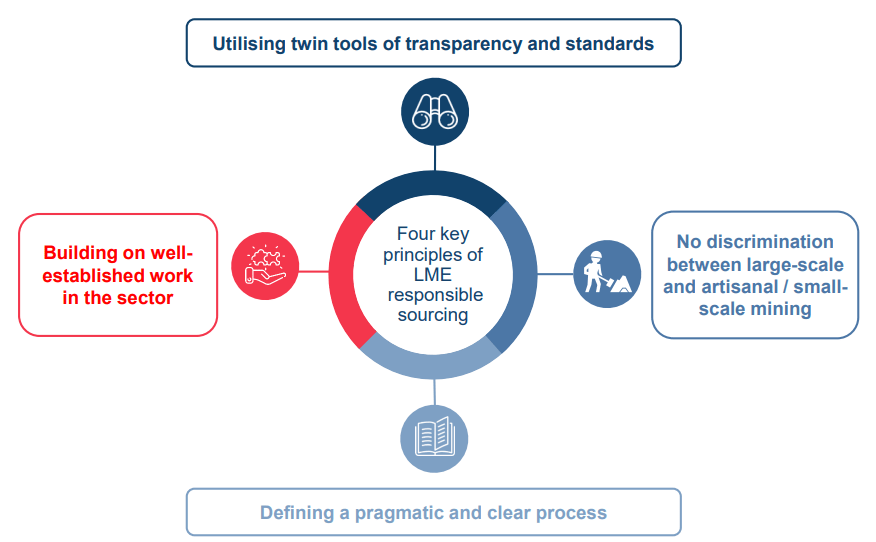
Transparency and standards
The LME’s approach combines transparency with standards. Both elements together provide a level playing field that is fair for producers, while ensuring that consumers receive metal which meets globally accepted standards.
Transparency allows consumers to understand the steps producers are taking to ensure responsible sourcing. Since April 2025, the LME has strengthened this principle by introducing mandatory public disclosure requirements (PDF) across all listed brands.
The LME’s responsible sourcing approach builds on established industry frameworks and due diligence standards, leveraging the work of recognised bodies to ensure alignment with international best practice. By adopting standards that meet the Organisation for Economic Co-operation and Development’s (OECD) Guidance, the LME provides a consistent, practical framework that integrates easily into existing operations while promoting credibility and comparability across the metals supply chain.OECD guidance
The LME has based its approach on the OECD’s Due Diligence Guidance for Responsible Supply Chains of Minerals from Conflict-Affected and High-Risk Areas (PDF) – the most recognised reference in this area.
Companies must utilise the five-step framework to establish management systems, identify risks, and take appropriate mitigation action, a process which – combined with appropriate transparency – provides a consistent and widely accepted model to ensure all metals brands can address supply chain risks consistently and effectively.
Large scale and small scale/artisanal mining
Careful consideration has been given to make sure that there is no discrimination between large-scale and artisanal or small-scale mining. The livelihood of millions of people is dependent on artisanal mining and for that reason, sufficient time to implement the responsible sourcing requirements has been allowed, in order to ensure that all producers have sufficient time to comply.
Challenges often more associated with large-scale mining, such as financial crime and corruption, are addressed through the requirement to make disclosures under the Extractive Industries Transparency Initiative (“EITI”) in EITI member countries. Brands sourcing from non-EITI member countries are also encouraged to make disclosures in line with the EITI principles.
Clear and pragmatic
Throughout the whole process the LME has sought to ensure that its approach is not only clear, but achievable. With that in mind, there are a number of paths that producers can take to ensure compliance, all within a transparent and practical structure.
What are the LME responsible sourcing requirements?
By way of a reminder, the LME responsible sourcing requirements are in addition to the existing brand listing requirements, and apply uniformly to all physically settled metals.
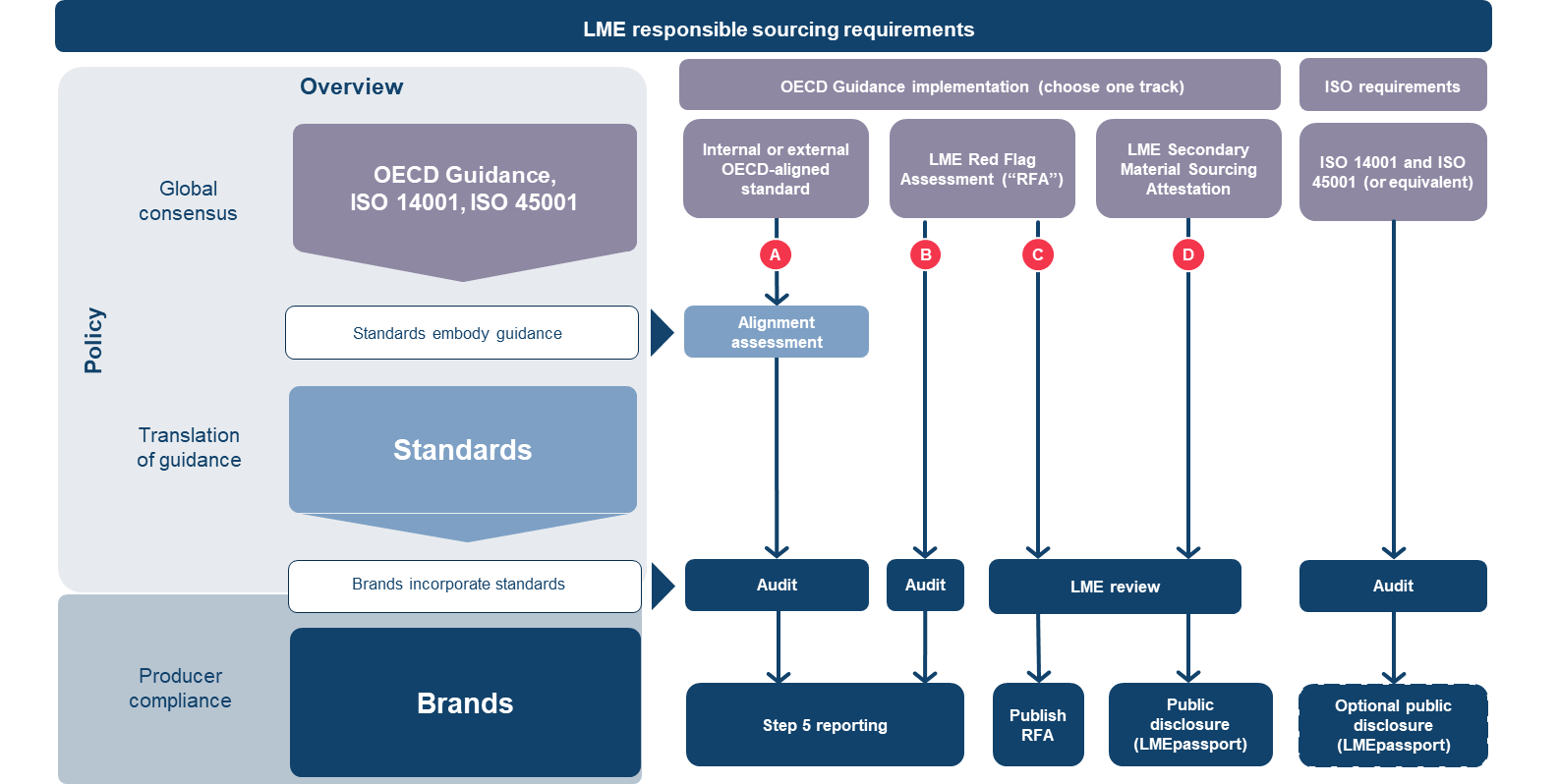
The LME has developed several “tracks” (see below) that producers can choose from, depending on their individual circumstances, to meet the LME responsible sourcing requirements. In addition, all brands will be required to hold a valid certificate for ISO 14001 and ISO 45001 (or equivalent), to ensure that environmental and occupational health and safety management systems are firmly embedded in their operations.
The requirements closely follow the OECD’s five steps, which can be summarised as follows:
- Step 1: Establish strong company management systems
- Step 2a: Identify risks in the supply chain
- Step 2b: Assess risk of adverse impacts
- Step 3: Design and implement a strategy to respond to identified risks
- Step 4: Carry out independent third-party audit of supply chain due diligence
- Step 5: Report on supply chain due diligence
For all brands sourcing primary material, the first stage is the establishment of company management systems and the identification of supply chain risks. After completing these stages, the brand can choose from four possible routes to reach LME compliance: Track A, B, C or D.
The choice of track will depend on the brand’s preferences and specific situation, including whether red flags have been identified.
Red flags are triggered in multiple ways, including if the origin of material cannot be established or the metal comes from Conflict-Affected and High-Risk Areas (CAHRAs). It is important to mention that raising a red flag is not a problem per se, it simply means that the brand needs to obtain additional information to provide confidence that the metal is responsibly sourced. It also means that the brand is required to follow track A and cannot be considered for track B or C.
The tracks:
Track A offers a route for all brands including those which have identified red flags. They can choose to align to an internal or external standard, such as those listed on the approved partners webpage. The standard needs to be independently verified as aligned with the OECD Guidance.
Track B and Track C offer a route for brands without red flags in their RFA template. If these brands do not wish to comply with a specific standard, they can fill out the RFA template and have the RFA audited by an approved auditor (Track B) or verified by the LME and subsequently published on the LME website (Track C).
Track D accounts for the specificities of secondary materials. Brands that source their input exclusively from secondary materials (sometimes known as “recycled”) can satisfy their requirements through the submission of the secondary-material sourcing attestation form without implementing the OECD 5 steps.
The following graph gives a visual overview of the individual tracks:
A detailed description of the responsible sourcing requirements and of each track can be found in the LME's Responsible sourcing handbook (PDF)
Future evolution
Consumer expectations and regulatory demands continue to advance, and the LME’s framework must evolve accordingly. At the same time, any new environmental or sustainability requirements will be introduced in a way that preserves market integrity and commercial viability. The LME’s approach is to widely seek market feedback and ensure that changes are practical and supportive of the physical market.
Since 2024, the LME has expanded its sustainability agenda beyond responsible sourcing to include carbon and broader environmental disclosures:
- CBAM integration: From 15 June 2025, the LME requires all listed aluminium brands (Primary Aluminium, Aluminium Alloy, NASAAC) to submit annual emissions reporting forms via LMEpassport in line with the EU Carbon Border Adjustment Mechanism (CBAM). These forms are linked to Certificates of Analysis (CoAs) and will become subject to independent verification from April 2027. This initiative supports compliance with EU CBAM and enhances emissions transparency across the aluminium value chain.
- Sustainability premia: In 2025, the LME announced plans to introduce price premia for sustainable metals. These premia will reflect verified sustainability credentials (beyond carbon footprint alone) for brands meeting robust criteria, disclosed through LMEpassport and supported by partnerships such as the LME–Metalshub collaboration for low-carbon nickel. The aim is to create transparent price signals that reward sustainability and drive market adoption of low-carbon and responsibly produced metals.
The LME’s broader sustainability strategy, first published in 2020, continues to evolve. LMEpassport remains central to this effort, enabling producers to share sustainability metrics, certifications, and now CBAM-related data. These developments reinforce the LME’s commitment to transparency and its role in supporting the global transition to a low-carbon economy.
Contact us
For further information please get in touch.
Contact us