


The LME uses a number of mechanisms to help manage excessive price volatility and avoid erroneous order entry:
- Daily price limits
- Static price bands
- Dynamic price bands
All contracts use dynamic price bands and either daily price limits (“DPLs”) or static price bands, and here we describe what each are, how, where and when they are used.
What is a daily price limit?
A daily price limit is the maximum allowable amount (expressed as a percentage) that the price of a contract can rise (“limit up”) or fall (“limit down”) in a trading day.
No orders (whether bids or offers) will be accepted above the upper DPL or below the low DPL. Once a limit has been reached, the LME may declare that a disruption event has occurred, within the meaning of the Disruption Event Framework (see below), to address the impact of the operation of DPLs on the establishment of LME Official Prices and LME Closing Prices in certain circumstances.
DPLs are expressed as a fixed percentage either side of the previous day’s relevant Closing Price for that contract. Changes in applicable percentages are notified to the market by notice, and the LME reserves the right to recalibrate these percentages periodically.
For the avoidance of doubt, DPLs are applicable to outrights only on LMEselect, LMEsmart and the Ring. See table below for more details.
To which metals and prompts do DPLs relate?
Base Metals
DPLs apply to all prompts on the main nine physically settled Base metals are configured and applied as a fixed percentage of the previous Business Day’s 3M Closing Price for that contract, applied equally to all prompts on the curve, as follows:
Cash-Settled Futures
DPLs apply to all prompts for Cash-Settled Futures Contracts listed below, and are configured and applied as a fixed percentage of the previous Business Day’s Month 2 Closing Price for that contract, applied equally to all prompts on the curve, as follows:
What are price bands?
Whereas DPLs determine how far a price can go up or down in a trading day, price bands create a "price channel" by setting the allowable maximum high bid price and the minimum low offer price around a reference (or "anchor") price which updates intra-day. There are two types: dynamic and static.
What are dynamic price bands?
Dynamic price bands move in line with a contract’s last traded price, plus or minus a USD value (which is a multiple of the NCR values), and are updated in line with market activity on the basis of every last “good” trade (subject to a tick tolerance). Orders outside this range will be rejected by LMEselect.
They are designed to be operational at all times during the trading day and will not be suspended except in the event of technical difficulties.
For dynamic price bands, the price channels can be adjusted between three pre-determined width options during the trading day to allow for increasing or decreasing market volatility.
In particularly volatile conditions in base metal contracts, the price channels can also be adjusted to a “Widest” setting to ensure that the dynamic are in operation at all price levels until such time as the DPL is reached, if applicable.
For more details on the LME’s price bands and how they are operated see:
LMEselect NCR Values October 2026 (PDF)
Price Bands and other Volatility Control Mechanisms (PDF)
What are static price bands?
Static price bands create a limit above and below a contract’s “anchor” price which is refreshed on a timed basis. No bids or offers will be accepted outside of this range.
If a contract trades to either of the static price band limits (up or down) the market remains open, but only bids below, or offers above the limit (depending which one has been hit) are permissible until the anchor price has refreshed and the limits recalculated.
Static Price Bands are applied to all base metal contracts and all cash-settled contracts, excluding LME Cobalt (Fastmarkets).
Static price bands are designed to be operational at all times during the trading day and will not be suspended except in the event of exceptional circumstances.
Intraday amendments to static price bands will only take place in exceptional circumstances if it is deemed to be in the best interests of the market to do so.
Volatility control mechanism by venue and contract
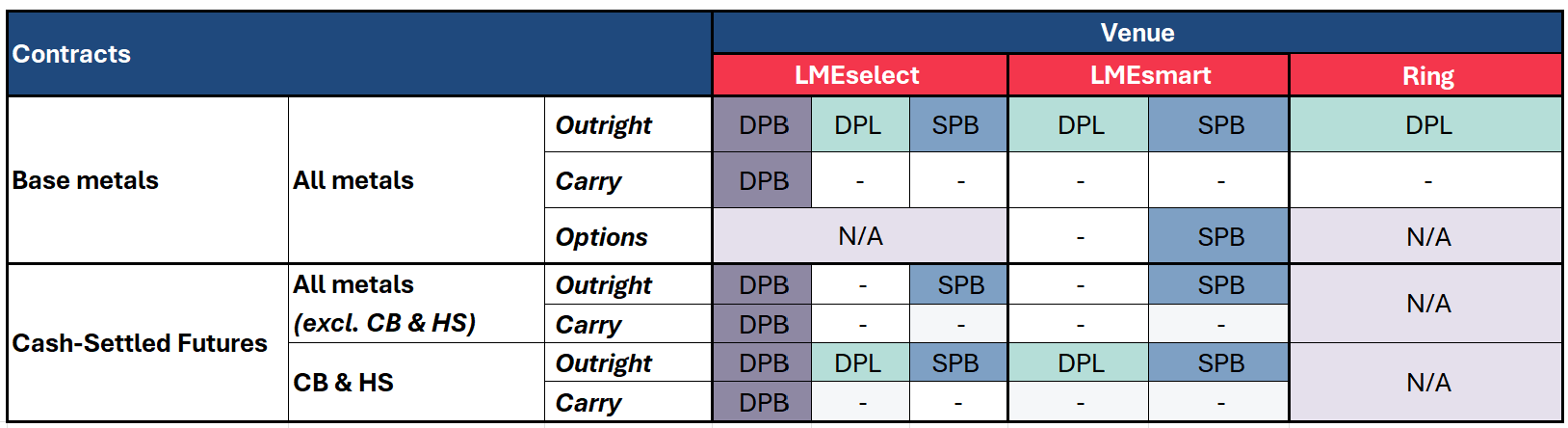
In cases where multiple controls are enabled for an instrument, the most stringent rule will be applicable.
Illustrative examples
Below are illustrative examples of how the suite of current volatility control measures are applicable on the LME market.
Interaction of dynamic price bands and daily price limits
- Figure 1 below illustrates the interaction between dynamic price bands (DPB) and daily price limits (DPL)
- The dynamic price band levels update based on trading activity on the basis of every last “good” trade (subject to a tick tolerance)
- As the price nears the DPL, the DPL becomes more constrictive (than the DPB) and the price cannot go higher despite the DPB being higher than the DPL.
Figure 1 - dynamic price bands

Note: the figures and levels are purely illustrative, and the visuals are not to scale.
Interaction of static price bands and daily price limits
- Figure 2 below illustrates the interaction between static price bands (SPB) and daily price limits (DPL).
- The static price band level are refreshed on a periodic basis (currently hourly), based on the metal’s “anchor price”
- As the price nears the DPL, the DPL becomes more constrictive (than the SPB) and the price cannot go higher despite the SPB being higher than the DPL.
Figure 2 - static price bands

Note: the figures and levels are purely illustrative, and the visuals are not to scale.
Disruption Event and Daily Price Limit Multiple Day Frameworks
The Disruption Event Framework was introduced by the LME in March 2022 following the implementation of DPLs pursuant to Decision Notice 24/134 of 2 April 2024.
This framework establishes a consistent and transparent approach for identifying, declaring and managing circumstances in which market disruptions affect the determination of the Official Prices or Closing Prices.
In addition, in June 2024, the LME also implemented the DPL Multiple Day Framework, following Consultation 23/235 and Decision Notice 24/134.
This deterministic framework aims to provide clarity to market participants on the actions the LME will take where a particular metal contract is impacted by DPLs multiple days in a row in the same direction.
It also sets out the factors the LME may take into account when considering whether to halt trading in an affected metal contract, including trading activity, liquidity, price movements and volatility in equivalent or related products traded on linked exchanges, and the interaction between those products and the relevant metal contract.
Applicable LME Member Notices
Contact us
For further information please get in touch.
Contact us