




Welcome to the March 2026 edition of the Sustainability Spotlight.
It has been some time since our last issue, and we are pleased to be back! In this edition, we reflect on a number of the key LME sustainability milestones achieved during 2025 and the start of 2026, including the launch of sustainable metals premia, progress on Carbon Border Adjustment Mechanism (CBAM) reporting, responsible sourcing, and more.
As in previous editions, we are pleased to feature a guest contribution offering fresh perspectives from across the metals ecosystem. This time, we are delighted to have Professor Andy Wetherelt from the Camborne School of Mines, University of Exeter as our guest writer. Since 2024, the LME Scholarship fund has been providing two full scholarships each year for graduate students at the Camborne School of Mines to support them on their journey toward forging a successful mining career. The scholarships are available to UK students, and successful candidates have the opportunity to gain work experience and/or mentoring support from LME staff.
LME Insight – the new solution for sustainable metals premium pricing
Marking a significant step forward in sustainable metals premium pricing, 6 February 2026 saw the debut of LME Insight, a new HKEX Group brand operated by Commodity Pricing and Analysis Limited (CPAL).
The launch followed the LME’s publication last October of its roadmap for the development of sustainable metals premium pricing (PDF).
LME Insight will deliver news and analysis across the metals market, with a strong focus on transition metals and adjacent industries. Pricing services are expected to follow later this year.
The publication of the confirmed pricing methodology also represents an important milestone – bringing us closer to establishing transparent, credible premium price discovery for LME-approved metals with enhanced sustainability credentials.
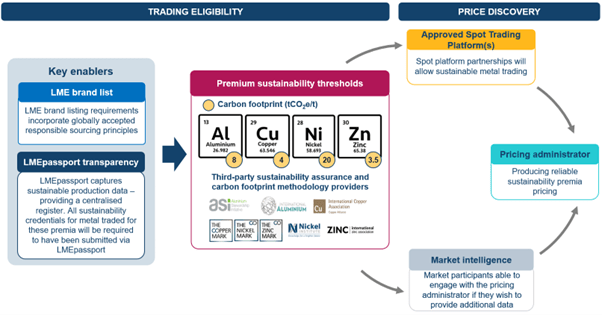
At present, aluminium, copper, nickel and zinc are within scope. Relevant LME-listed brands are required to meet verified sustainability threshold requirements, alongside existing LME brand listing criteria.
Key requirements for metals to be included in the LME’s sustainable metals premium pricing:
• Sustainability criteria disclosed via LMEpassport
• Alignment with an approved sustainability assurance provider
• Compliance with carbon thresholds in line with LME Insights’ approved methodologies
For more information on sustainable metals premium pricing, please visit LME Insight.
Update on CBAM at the LME
In 2025, the LME integrated the EU CBAM requirements into the LME Rulebook and implemented a mandatory emissions reporting obligation for all LME-listed primary aluminium, aluminium alloy and NASAAC brands.
As of December 2025, compliance levels have been strong with 99% of primary aluminium brands and 90% of aluminium alloy and NASAAC brands submitting their verified emissions data through LMEpassport, in line with the new rules.
Looking ahead, the next deadline for submitting embedded emissions data is 1 September 2026, in line with EU regulation; third-party verification of emissions data will become mandatory from 1 September 2027.
Responsible sourcing
We are pleased to share the latest updates from the responsible sourcing programme – you can read the full update in the Reflection on Year Four, which was published in February 2026.
There are two key developments for producers following the LME’s Track A standard alignment assessment. In the last six months, the European Commission recognised the Responsible Minerals Initiative (RMI) Responsible Minerals Assurance (RMAP) Process, Tin and Tantalum Standard as supporting compliance with the EU Conflict Minerals Regulation. The LME now also recognises this standard as fully meeting Track A requirements. The final alignment assessment report of the Tin and Tantalum Standard is now published on the EU Commission website. Separately, the RMI’s Global Responsible Sourcing Due Diligence Standard for Mineral Supply Chains All Minerals has also been assessed to be fully aligned with the OECD alignment assessment criteria for Standard and Implementation, thereby fully meeting LME Track A requirements.
As part of our continued focus on transparency, the Red Flag Assessments (RFAs) submitted in 2025 have now been published and are available here. They were published either in anonymised form on the LME website or as attributed versions on LMEpassport, depending on brand producers’ preferences.
We are pleased to see a number of producers voluntarily submitting attributed RFAs ahead of next year’s mandatory requirements. This growing willingness to be transparent about sourcing practices reflects a strong and increasing industry-wide commitment to responsible sourcing.
From 2027 onwards, all Track C brand producers will be required to disclose attributed versions of their RFAs.
LMEpassport
We have been working to streamline the process for responsible sourcing submissions on LMEpassport, enhancing how producers interact with and report through the platform. As a result, Track A producers can now submit audit reports and ISO certificates directly via the platform.
Since Q2 2025, each brand’s responsible sourcing compliance track, along with the associated public disclosures and ISO certificates (or equivalent), have been made publicly available on LMEpassport. This increased transparency supports smoother reporting and easier stakeholder review.
As of February 2026, there are 1,445 sustainability disclosures spanning 57 different sustainability certifications and metrics on the platform, providing a substantial level of detail for stakeholders.
UK Critical Minerals Strategy
The LME plays a pivotal role in enabling price discovery, risk management and market access across global critical minerals supply chains.
In November 2025, the UK government published its latest critical minerals strategy. The LME was included within this paper as a key case study exemplifying the importance of the broader UK financial and mining ecosystem. For more information on the UK government’s critical minerals strategy, you can read the policy paper.
LME Week 2025
LME Week 2025 took place in London in October, bringing together market participants for a week of networking, discussion and industry events.
At the LME Metals Seminar, sessions covered topics from decarbonisation and sustainable metal premia to geopolitics and supply chain resilience.
A fireside chat between LME CEO Matthew Chamberlain and Trafigura CEO Richard Holtum, highlighted the importance of critical mineral supply chain security and the ways in which the energy transition continues to reshape metals markets.
You can watch all the seminar sessions on our dedicated LME Metals Seminar web page.
LME wins ESG award
We are proud to have received the Best ESG Industry Initiative of the Year Award at the Resourcing Tomorrow Awards. This recognition reflects our efforts in developing premium pricing for sustainable metals, supporting the industry in recognising and unlocking the potential value of more sustainable metal production.
Market Insight
This edition’s Market Insight, “Nurturing Talent Pipelines in the Mining Sector” comes from Professor Andy Wetherelt, Camborne School of Mines, University of Exeter.

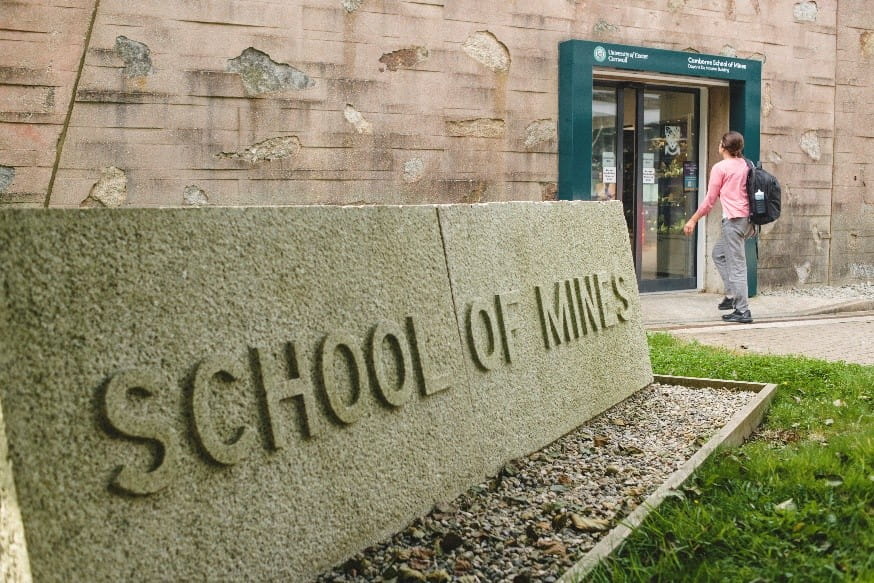
Professor Wetherelt is the Programme Director for Undergraduate Mining programmes at the Camborne School of Mines (CSM) in the UK. CSM has been providing world-class geoscience and mining education for more than 130 years. The School is based at the University of Exeter’s Cornwall campus, a location which offers unique opportunities to collaborate with the region's rich natural resources and thriving sustainability initiatives.
Andy joined the University of Exeter in April 1991. Prior to his appointment he worked for South Crofty Plc, Gold Fields of South Africa and Eurotunnel. Andy’s research interests cover 3D remote surveying, underground tunnel orientation and blast vibration analysis. He is a Member of the Institute of Mining and Metallurgy, and a Fellow of the Institute of Quarrying.
Nurturing Talent Pipelines in the Mining Sector
The mining industry stands at a pivotal moment. Demand for critical minerals is soaring, driven by electric vehicles, renewable energy technologies, and the global race to reach net zero, but attracting enough young people into mining engineering and geoscience remains stubbornly difficult. At CSM, we see both sides of this tension every day: the enormous opportunity ahead, and the challenge of ensuring we have the skilled people to meet it.
For many prospective students, the first barrier appears long before they set foot on campus: the rising cost of higher education. The fear of walking away with tens of thousands of pounds of student debt is very real, and it understandably shapes decision making. At the same time, mining still suffers from an outdated reputation that puts off those who might otherwise flourish in the sector. Too often, people picture a “dirty, dangerous” past instead of the modern, technologically advanced industry that underpins the green transition.
The good news? Mining companies can play a transformative role in fixing both issues.
Scholarships and bursaries: opening the door to the industry
Let’s start with the simplest and most impactful tool companies have – financial support.
Scholarships and bursaries genuinely change the trajectory of young people’s lives. When students learn that a mining company can help cover their academic fees or living costs, everything shifts. Parents who are wary of long term debt suddenly feel relief. Students who weren’t sure university was financially possible begin to see a future that includes higher education and, crucially, a future in mining.
At CSM, we’ve witnessed this time and again. When a company puts its name behind a scholarship, it signals a commitment not just to an individual, but to the next generation of mining talent. And it’s mutually beneficial: industry invests early in people who could become future employees, ensuring the talent pipeline remains healthy.
The LME’s scholarship support of our students is a perfect example – practical, visible, and genuinely life changing for its recipients. But individual mining companies can also play a significant role. Whether sponsoring one student or fifty, the impact is both immediate and long lasting.
Placements and graduate pathways: from first hello to career launch
Once students arrive, the next step is showing them what mining really looks like. This is where placements and graduate roles become indispensable, and they work best when they’re connected.
Vacation placements are often the moment when career decisions crystallise. After eight weeks on site, shadowing engineers, contributing to operational tasks, observing the scale and significance of modern mining, students gain an understanding no lecture theatre can match. Companies benefit too. A placement is essentially a very long interview, giving employers the chance to see a student’s work ethic, curiosity, and potential.
For master’s students, industry-linked dissertation projects are especially powerful. These are not theoretical exercises; they solve real problems. Students gather data on site, analyse it, and deliver insights a company can genuinely use. Some of these projects even result in published papers for the students, and for companies it’s a free pair of hands with advanced technical training.
Graduate roles and schemes then provide a natural continuation. Students who’ve been supported, mentored, and welcomed into a company during their studies transition smoothly into full-time roles. The loyalty is already there. The learning curve is shorter. And companies secure talent they’ve watched develop from day one.
Visibility on campus: the power of just showing up
One of the easiest ways companies can support talent pipelines is simply to be seen. Students cannot aspire to a career they’ve never encountered. This is why industry engagement is essential – on campus, in classrooms, and here at CSM, often over a pint and a pasty! We find these informal events are consistently some of the most effective recruitment moments. Companies chat openly about day-to-day operations, career paths, international travel, site life, and the excitement of the job. Students ask questions they’d never think to ask in a formal setting.
But perhaps the biggest impact comes from recent graduates. When a 24-year-old stands in front of our students – whether in-person, or on a video from a site in Western Australia – and explains how they graduated 18 months ago and now manage a section of an open pit, it lands in a way no brochure or campaign ever could. These interactions make the industry relatable and real. They also shatter stereotypes.
Changing the narrative: mining as a net-zero enabler
A final critical role companies can play is in helping reshape public understanding of mining.
Modern mining is not the coal-stained stereotype of decades past. It is high tech, essential, and central to achieving net zero. Without mining, we will not have electric vehicles, wind turbines, mobile phones, or battery storage. Without secure supplies of copper, lithium, cobalt, rare earths and tin, the global energy transition simply cannot happen. We all know this, but too few young people (and too few parents) are armed with this knowledge.
Industry has the credibility and the responsibility to tell this story. Through outreach, media engagement, school visits, and partnerships with universities, companies can help the next generation see mining as a future focused, globally significant, technologically advanced sector. One that offers opportunity, purpose and impact.
A shared responsibility for the road ahead
At Camborne School of Mines, as well as other institutions around the world, we’re working hard to rebuild and strengthen mining education, but we can’t do it alone. Nurturing the next generation of mining engineers and geoscientists requires collaboration between universities and the companies who will ultimately employ these graduates.
The formula is straightforward:
• Scholarships and bursaries bring students in
• Placements and graduate pathways keep them engaged and help them build meaningful early careers
• Campus visibility inspires them and demystifies the sector
• A refreshed narrative empowers them to feel proud of choosing mining
If we can all work together across these roles the pipeline of talent will not only grow, it will thrive, and the industry will be better equipped to meet the enormous challenges and opportunities of the years ahead.
Let’s invest, not just in mines, but in the people who will keep them running for decades to come.
*The views expressed in this article are the observations of Camborne School of Mines and are not necessarily reflective of the LME’s position*
Want to get involved?
Interested in contributing to a future newsletter or getting involved in a working group? Email us!